
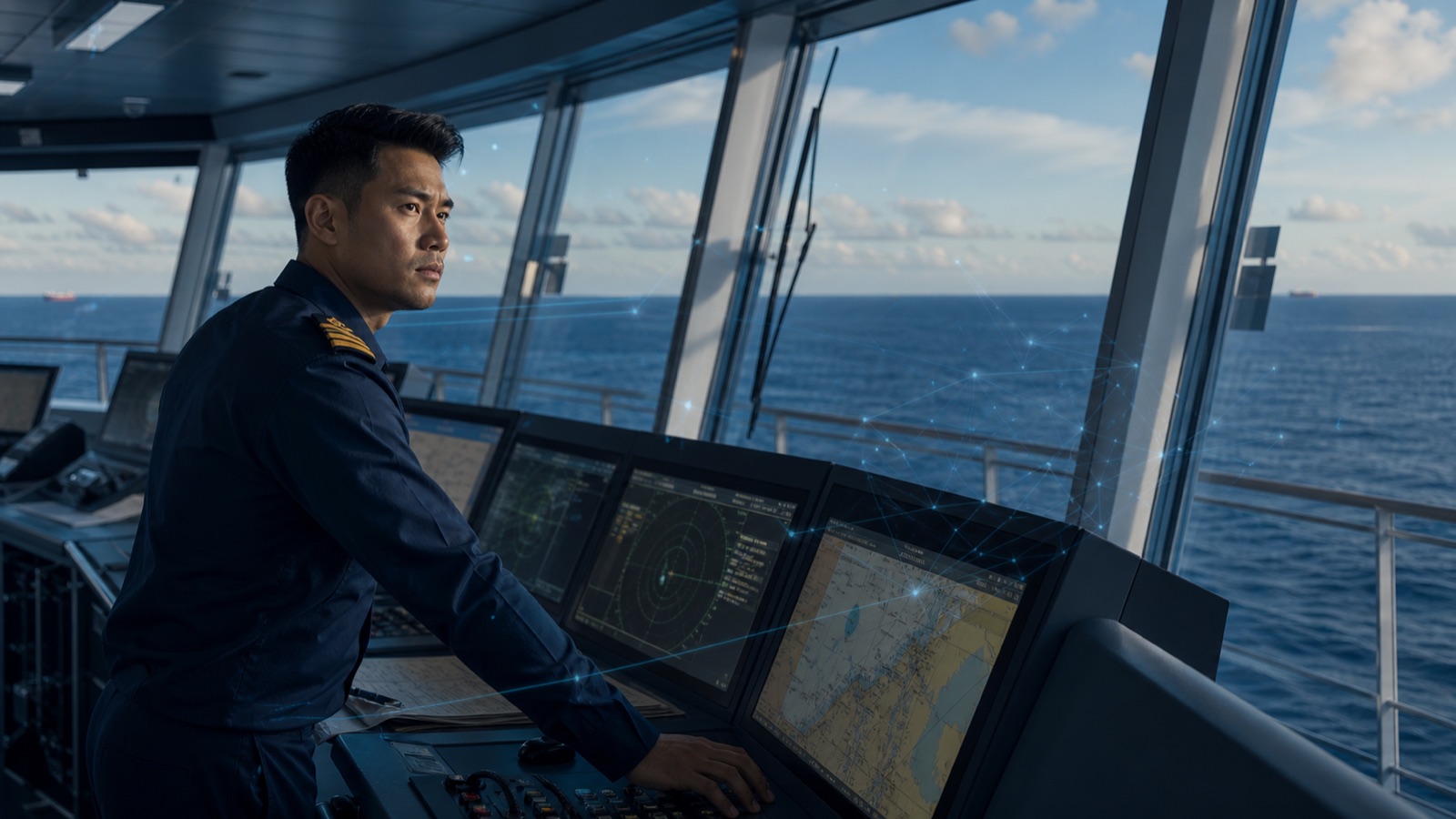
title: "Digital Seafarer Skills: Working Safely With Automation and Connected Ships"
excerpt: "The durable human skills seafarers need as automation, data, and connected systems become more common onboard."
meta_description: "Build digital seafarer skills for automation, data quality, situational awareness, cyber hygiene and safe manual fallback."
focus_keyword: "digital skills for seafarers"
tags: [digital skills, automation, human element, cyber safety, careers]
—
# Digital Seafarer Skills: Working Safely With Automation and Connected Ships
Modern ships combine sensors, software, electronic charts, machinery controls, communications, cargo systems, and shore connections. Automation can support safer and more efficient work, but it can also create new failure modes, information overload, and overconfidence.
The IMO’s human-element work recognises that safety depends on the interaction of people, organisations, technology, and training. Digital skill is therefore not just pressing buttons. It is understanding enough to use technology critically and safely.
Maintain situational awareness
Automation output is one source of information, not reality itself. Compare displays with independent indications, physical conditions, procedures, and team observations. Watch for outdated inputs, wrong modes, sensor failure, unit differences, or settings carried over from a previous operation.
Ask yourself:
- What is the system currently controlling or advising?
- Which inputs does it depend on?
- How will I recognise degraded performance?
- What requires human confirmation?
- What is the safe fallback?
If system output conflicts with observed conditions, follow bridge, engine, cargo, and safety procedures rather than forcing reality to match the screen.
Understand modes and handovers
Many automation errors involve misunderstanding which mode is active, what authority the system has, or who is monitoring. During handover, state configuration, limitations, alarms, overrides, maintenance, and unresolved anomalies explicitly.
Do not assume the next person sees what you see. Use closed-loop communication: give the information, receive confirmation, and correct misunderstanding.
Treat data quality as seamanship
Digital reports influence maintenance, performance, safety, and compliance. Enter data according to definitions and at the correct source. Avoid copying old values merely to fill fields. Report faulty sensors, duplicated entry, unclear units, and impossible deadlines.
Good systems reduce repeated manual work. Companies should ask crew where forms and interfaces create error rather than adding another spreadsheet after every incident.
Practise safe fallback
Crew should know what happens when connectivity, a sensor, a workstation, or automation is unavailable. Familiarisation should include degraded modes and manual skills appropriate to the role. A fallback is only real if it is documented, accessible, understood, and practised safely.
Never experiment with a live safety-critical system. Use approved simulation, training, drills, and supervised practice.
Use basic cyber hygiene
Connected ships expand cyber exposure. Verify unexpected messages, use approved removable media, protect credentials, lock shared terminals, and report unusual behaviour promptly. Keep personal devices and accounts separated from operational systems under company policy.
Cyber reporting should be blame-aware: hiding an accidental click can turn a small event into a larger one. Leaders should reward early reporting and investigate system causes.
Build a portable learning record
Record courses, equipment familiarisation, simulator work, supervised tasks, and competence assessments. Learn concepts that transfer across vendors: inputs, outputs, modes, alarms, limitations, data integrity, communication, and fallback.
Before paying for a course, confirm it is relevant and, where required, approved by the competent authority. Technology brand certificates may be useful, but they do not replace statutory competence.
Human skills become more important
Automation increases the value of judgement, teamwork, curiosity, clear communication, and the ability to detect weak signals. A strong digital seafarer can explain what the system is doing, challenge it appropriately, and work safely when it is unavailable.
Authoritative references
Image guidance
OFFICIAL REFERENCES
Verify at the source
- View official guidance ↗www.imo.org
- View official guidance ↗www.imo.org
- View official guidance ↗www.imo.org
This guide provides general educational information. Requirements and remedies depend on the vessel, flag, contract, collective agreement and circumstances. Seek qualified help for your case.