
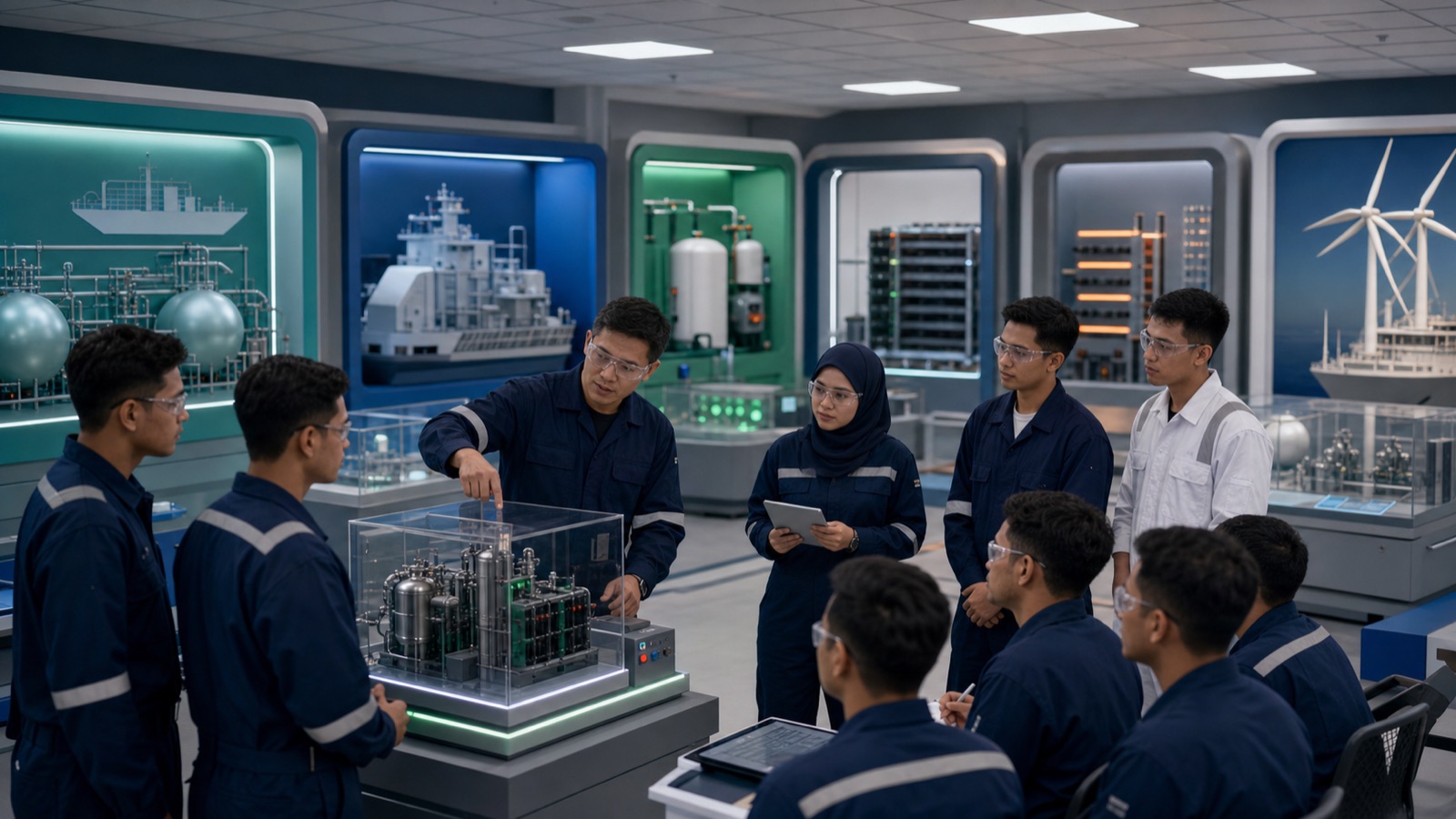
title: "Alternative Fuels at Sea: New Skills, New Hazards, Same Safety Discipline"
excerpt: "A safety-first guide to questions seafarers should ask as ships adopt unfamiliar fuels, batteries, and propulsion technologies."
meta_description: "Learn the safety, training and competence questions seafarers should ask as ships adopt alternative fuels and new technology."
focus_keyword: "alternative fuels seafarer training"
tags: [alternative fuels, safety, training, STCW, decarbonisation]
—
# Alternative Fuels at Sea: New Skills, New Hazards, Same Safety Discipline
There is no single replacement for conventional marine fuel. Shipping is exploring different fuels, energy carriers, batteries, wind assistance, and efficiency technologies. Each option brings a different design, supply chain, operating profile, and hazard set.
The durable rule is simple: unfamiliar technology requires specific competence. A seafarer should not be expected to infer safe operation from experience with a different system.
Begin with the vessel—not the fuel headline
Public discussion may describe a fuel as “green,” “clean,” or “the future.” Those labels do not explain its shipboard risks. Safe work depends on the exact system, containment, ventilation, detection, materials, procedures, maintenance, emergency arrangements, and crew competence.
Before taking responsibility, ask:
- Which hazards are new or significantly different?
- How are leaks, fire, exposure, or loss of containment detected?
- What PPE and monitoring equipment apply?
- Which spaces have access restrictions?
- How do bunkering and isolation procedures differ?
- What emergency actions and medical response are required?
- What approved training and familiarisation apply to my role?
Follow vessel-specific documentation and qualified instruction. A general article should never provide handling steps for hazardous fuels.
Training must match responsibility
Watching a video or signing a familiarisation sheet is not automatically competence. Training should connect knowledge, supervised practice, emergency response, and assessment. Refresher needs may emerge as systems and standards change.
Keep evidence of courses, onboard familiarisation, drills, and tasks performed. Ask how new competence affects certification and career progression. Marine administrations and IMO resources should be checked for current requirements.
Human factors can create hidden risk
New systems may add alarms, interfaces, permits, inspections, data entry, and maintenance. Poorly designed change can increase cognitive load and fatigue. Mixed fleets create another challenge when crew move between technologies.
Companies should provide:
- Clear operating limits and alarm priorities.
- Time to learn before independent duty.
- Accessible technical and shore support.
- Realistic manning and workload assessment.
- Procedures for conflicting or failed automation.
- A feedback loop for defects, near misses, and confusing design.
Crew should report uncertainty early. Pretending to understand is more dangerous than asking for clarification.
Safety and environmental goals must align
Emission reduction is important, but an environmental target does not permit unsafe shortcuts. Risk controls, work-rest requirements, maintenance, emergency preparedness, and pollution prevention continue to apply.
When operational pressure conflicts with safe limits, follow the safety management system and escalation path. Record facts and seek union or qualified advice when necessary.
Change also affects wellbeing
Rapid technical change can create anxiety about jobs, examinations, and professional identity. ISWAN has drawn attention to seafarers’ wellbeing during decarbonisation. Good implementation tells crew what is changing, why, when training will happen, and how competence will be recognised.
Seafarers can focus on transferable strengths: risk awareness, teamwork, procedures, systems thinking, communication, accurate records, and willingness to learn.
Personal readiness checklist
- I know the system and version installed on this vessel.
- I completed role-appropriate training and familiarisation.
- I know where current procedures and safety data are located.
- I understand alarms, access limits, PPE, and emergency routes for my role.
- I know who to contact when the system behaves unexpectedly.
- I will stop assumptions and report uncertainty.
Authoritative references
- IMO: Climate action and clean air in shipping
- IMO: STCW Convention
- ISWAN: Decarbonisation and seafarer wellbeing
Image guidance
OFFICIAL REFERENCES
Verify at the source
- View official guidance ↗www.imo.org
- View official guidance ↗www.imo.org
- View official guidance ↗www.iswan.org.uk
This guide provides general educational information. Requirements and remedies depend on the vessel, flag, contract, collective agreement and circumstances. Seek qualified help for your case.