
title: "Shipping Decarbonisation: What EEXI, CII, and SEEMP Mean for Crew"
excerpt: "A crew-focused introduction to shipping efficiency rules, operational change, training, workload, and safety-first implementation."
meta_description: "Understand EEXI, CII and SEEMP in plain language and what shipping decarbonisation can mean for seafarers and operations."
focus_keyword: "shipping decarbonisation seafarers"
tags: [decarbonisation, EEXI, CII, SEEMP, green skills]
—
# Shipping Decarbonisation: What EEXI, CII, and SEEMP Mean for Crew
Shipping is under pressure to reduce greenhouse-gas emissions. IMO measures include technical and operational requirements intended to improve energy efficiency. Seafarers may experience the transition through new procedures, data collection, voyage planning, maintenance, speed or power management, unfamiliar equipment, and additional training.
The transition must remain safe and seafarer-centred. Efficiency targets do not justify fatigue, understaffing, or unsafe operation.
Three common terms
EEXI — Energy Efficiency Existing Ship Index: a technical measure related to the energy efficiency of existing ships.
CII — Carbon Intensity Indicator: an operational measure used to rate carbon intensity based on ship operation and transport work.
SEEMP — Ship Energy Efficiency Management Plan: a ship-specific management framework for improving and monitoring energy efficiency.
These short definitions are orientation only. The calculations, application, and compliance responsibilities belong with qualified personnel and current IMO and administration requirements.
What may change onboard
Depending on the vessel, crew may see:
- More detailed fuel and operational data collection.
- Revised voyage and speed planning.
- Engine power limitation or other technical measures.
- Increased attention to hull, propeller, trim, and machinery condition.
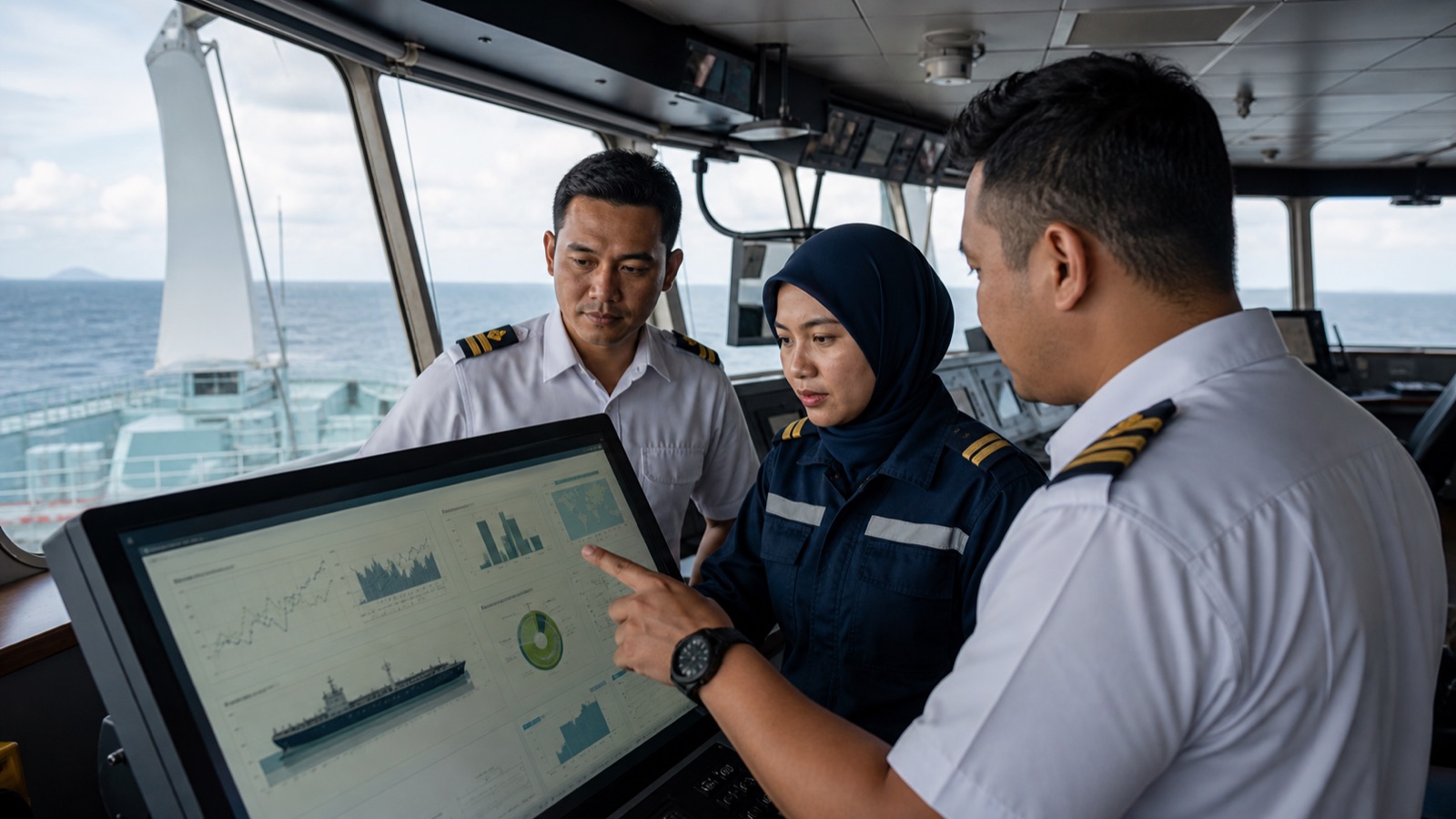
- New dashboards, sensors, and reporting tasks.
- Wind-assist, batteries, alternative fuels, or other technology.
- New drills, permits, maintenance, and competence requirements.
Every change should include familiarisation, documented risk assessment, clear responsibilities, and safe fallback arrangements.
Data quality is a human-factor issue
Efficiency decisions depend on reliable data. Crew need practical definitions, calibrated equipment, realistic time, and feedback on how data is used. Repeated manual entry across disconnected systems increases workload and error.
Report faulty sensors, unclear fields, conflicting definitions, or pressure to alter data. Companies should simplify processes and explain purpose rather than treating every discrepancy as individual failure.
Protect safety and rest
Operational optimisation may change arrival times, maintenance windows, or workloads. Monitor whether new routines compress rest or shift work into already busy periods. Raise fatigue and manning concerns through the safety-management system.
IMO’s efficiency approach is technology-neutral. It does not remove SOLAS, STCW, MARPOL, MLC, or other safety and labour responsibilities.
Training should precede responsibility
Before working with new fuel, propulsion, energy storage, or automated control, crew should receive approved and role-appropriate training and familiarisation. Ask:
- What has changed from the previous system?
- What new hazards and emergency actions apply?
- Which alarms or limitations are safety-critical?
- What competence must be demonstrated?
- What is the manual or safe fallback?
- How will near misses and workload effects be reviewed?
Do not learn hazardous operation by trial and error.
Wellbeing belongs in the transition
ISWAN research highlights concern that rapid decarbonisation and technological change can affect wellbeing and job satisfaction. Uncertainty about competence, career security, and constant change can create stress. Operators should include crew in implementation, communicate timelines, provide training, and monitor technostress and social effects.
For seafarers, maintain a training record and ask for clear evidence of competence gained. New environmental knowledge can strengthen careers when learning is accessible and recognised.
Authoritative references
- IMO: Improving the energy efficiency of ships
- IMO: Climate action
- ISWAN: Impact of maritime decarbonisation on wellbeing
Image guidance
OFFICIAL REFERENCES
Verify at the source
- View official guidance ↗www.imo.org
- View official guidance ↗www.imo.org
- View official guidance ↗www.iswan.org.uk
This guide provides general educational information. Requirements and remedies depend on the vessel, flag, contract, collective agreement and circumstances. Seek qualified help for your case.